

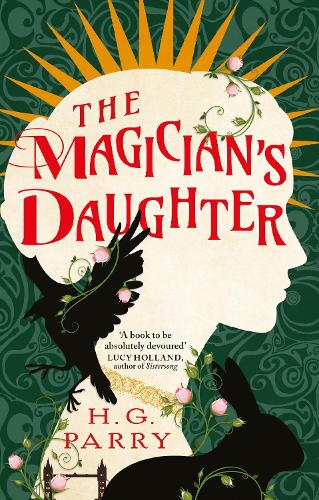
The Magician’s Daughter by H. G. Parry
★★★★
Reviewed by Jo-Anne Blanco
Genre: Fantasy, Historical Fiction
Time Period: Early 20th Century
Europe by Region: UK (Britain) & Ireland
Subgenres/Themes: Coming of Age, Magical or Supernatural Elements
An enthralling, enchanting story set in a world of fairy tales and folklore, in which sixteen-year-old Biddy leaves her sheltered childhood behind to help save magic and learn the truth that has been hidden from her all her life.
Review
“Magic isn’t there to be hoarded like dragon’s treasure. Magic is kind. It comes into the world to help. Our job is to make sure it gets to where it needs to go.”
In H. G. Parry’s novel The Magician’s Daughter, sixteen-year-old Biddy lives on the wild, remote, hidden island of Hy-Brasil, cloaked from the world by powerful magic. Her home is an island of fairy stories and folktales, shadowy forests and mysterious castle ruins, black rabbits, and a golden-eyed, shape-shifting animal spirit known as a Púca. Since she washed up on the island in a lifeboat as a baby, Biddy has been brought up by the mage Rowan and his familiar, a rabbit-sometimes-turned-human named Hutchincroft, the only people she has ever known. Through them, she learns that magic is everywhere; in every star, every leaf, and every grain of sand.
Rowan, a powerful magician, regularly transforms himself into a raven to make trips to the mainland for supplies. But Biddy never leaves Hy-Brasil, and her entire worldview stems from books she grows up reading and lessons in spells taught to her by Rowan, even though she understands that she is not a mage herself. Nonetheless, with her origins shrouded in mystery, Biddy dreams she is destined for a great purpose. No longer a child, she finds herself caught between worlds: between her idyllic past childhood and the adulthood for which she yearns and has read about in books; and between the isolated, magic-infused world of Hy-Brasil and the world she longs to see that lies beyond.
However, Rowan’s trips as a raven ominously begin to result in him coming back wounded and one night he does not return at all. Biddy’s use of a spell to find him sparks a series of devastating revelations about the outside world, the perilous place of magic in it, and the true mystery about herself. At last, Biddy will get to leave Hy-Brasil, but only to embark upon a dangerous journey to discover the truth and save magic…
The early chapters of this novel superbly evoke the beauty, wonder, and fairy-tale aura of Hy-Brasil, the joys and adventures of Biddy’s childhood and adolescence, and her deepening relationships with her adopted father and his familiar. The sense of place on the island is powerfully rendered, lending the vivid descriptions an air of enchantment and mystery, while invoking a history that reaches far back into the mists of time. But, like all fairy tales, the initial idyll cannot last, and darkness must ultimately be faced and fought.
The tone of the book effectively changes with Biddy’s impressions of a human world new and unknown to her, dealing perceptively with the sudden shock of crowds of people, trains, chimneys, noise, smells and smoke. The memories of Hy-Brasil and Biddy’s knowledge gleaned only through books provide a stark contrast to the later chapters’ gritty, haunting rendition of the outside world, particularly 1912 London, ravaged by poverty and illness. At the orphanage where she goes to work undercover, Biddy is forced to awaken to a grim reality that would have been hers but for a twist of fate. Through her journey of discovery, it becomes clear that the magical world outside of Hy-Brasil mirrors the darkness and cruelty of the ordinary mortal world in many ways, and Biddy’s choices in the face of what she learns make her a sympathetic and compelling protagonist.
Given that the entirety of the novel is told from Biddy’s teenage POV, it is understandable that there is less insight into some of the other characters, though it does feel that at times it would serve the story well to understand some of their motivations better. One of the more sinister, complex, and resonant of the villains is built up powerfully throughout the narrative, only to make a rather abrupt volte face towards the end, and the dénouement is somewhat too easily resolved as a result. The ending, too, feels a little unfinished, as though there is more of the story left to tell, but, nevertheless, The Magician’s Daughter is a captivating, erudite, beautifully written fantasy about growing up, being unselfish, showing courage, and doing the right thing.
Jo-Anne Blanco for BookBrowse
©Jo-Anne Blanco 2023

0 Comments