

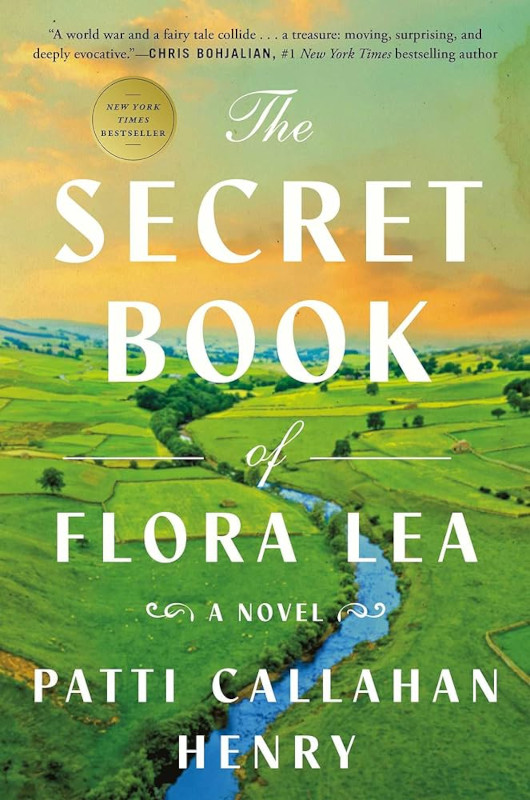
The Secret Book of Flora Lea by Patti Callahan Henry
★★★★
Reviewed by Jo-Anne Blanco
Genre: Historical Fiction, Mystery
Time Period: 1940 and 1960
Major Regions: United Kingdom, USA
Subgenres/Themes: Generational & Family Sagas, Dealing with Loss
In 1940, two sisters are evacuated to the countryside during World War Two and, while there, tragedy strikes. Twenty years later, the elder sister receives a book that takes her on a journey to discover the truth about what happened all those years ago…
In Patti Callahan Henry’s new novel The Secret Book of Flora, sisters Hazel and Flora Lea Linden are evacuated to Binsey, Oxfordshire at the beginning of World War II, in the mass evacuation of children from London known as Operation Pied Piper. Despite their nine-year age difference, Hazel, 14, and Flora, 5, are close. To help her younger sister and get them both through the horror of the war, the loss of their father, and the trauma of being evacuated away from their mother, Hazel creates a magical woodland world called Whisperwood and the River of Stars, a safe and magical place just for them. Using their imagination and Hazel’s storytelling gifts, they escape through shimmering hidden doors to this magical land, where they can become any creatures they want to be and go anywhere they want to go. Whisperwood is a secret known only to the two sisters, but when a tragedy occurs, Hazel abruptly stops telling stories and abandons her dreams of becoming a writer.
Twenty years later, Hazel is about to leave her job at Hogan’s Book Shoppe in Bloomsbury, London, for a new position as a specialist in rare books and manuscripts at Sotheby’s. On her last day at the bookshop, she is cataloguing a set of new arrivals when among them she finds a new fairy tale by an American author named Peggy Andrews with illustrations by Pauline Baynes, the original illustrator of C. S. Lewis’ Narnia books. The first illustration she finds is one of two girls in a magical woodland with a white castle and a river full of stars. The book’s title is Whisperwood and the River of Stars, and brings with it the terrible memories and loss of twenty years before. How does the American author know about the secret world of the two English sisters in wartime Oxford?
“Lying, the telling of beautiful things, is the proper aim of art.” Oscar Wilde’s famous quote is repeated by the character of Peggy, the American author whose book is the catalyst for the events of the 1960 strand of the story. “Beautiful untrue things carry the truth,” Peggy says, encapsulating one of the core themes of this novel. Hazel’s hunt for the truth as to how and why a young American author knows the secret story she created for her sister when they were children takes her and the reader on a compelling, poignant journey involving a number of twists and turns, similar to the winding trail through Whisperwood itself. Sometimes she is led to dead ends, but the spark of hope remains ever alive that what happened in the past may not be what it seemed, and that the truth can be found in the journey of the story itself. Travelling back and forth through time, the mystery at the heart of the novel is skilfully unravelled, events and memories gradually unlocking the grief and guilt at the center of Hazel’s life.
In the 1940 story of Hazel and Flora, the misery, loneliness, and fear of evacuation are powerfully evoked, as is the idyllic Oxfordshire village where they are taken in by widow Bridie and her teenage son Harry. The reader’s immersion in the sisters’ world as children enhances our investment in the plot of the adult Hazel in 1960 uncovering the truth about the tragedy that haunts her: our empathy for her and everything she goes through deepens as the book progresses and reveals more about the past. Although there are occasions when Americanisms in 1940s England seem out of place (e.g. the children talk about “math” rather than “maths”), this is a minor language point. All the characters are well-drawn and convincing – even those who may not be deserving of sympathy are multi-faceted and their motivations believable if shocking.
Ultimately, it is the importance of stories and the necessity of storytelling that underpin everything in this beautiful, heartrending novel. Stories can bring us together, create an unbreakable bond between people, reveal things we might not otherwise be able to see about ourselves, our lives, and the world we live in; stories, even though imagined, can carry the truth. The title of the book may be The Secret Book of Flora Lea, but it is the story Hazel created which makes its way back to her across time and space, and finally leads her to the truth.
Jo-Anne Blanco for BookBrowse
©Jo-Anne Blanco 2023
0 Comments